
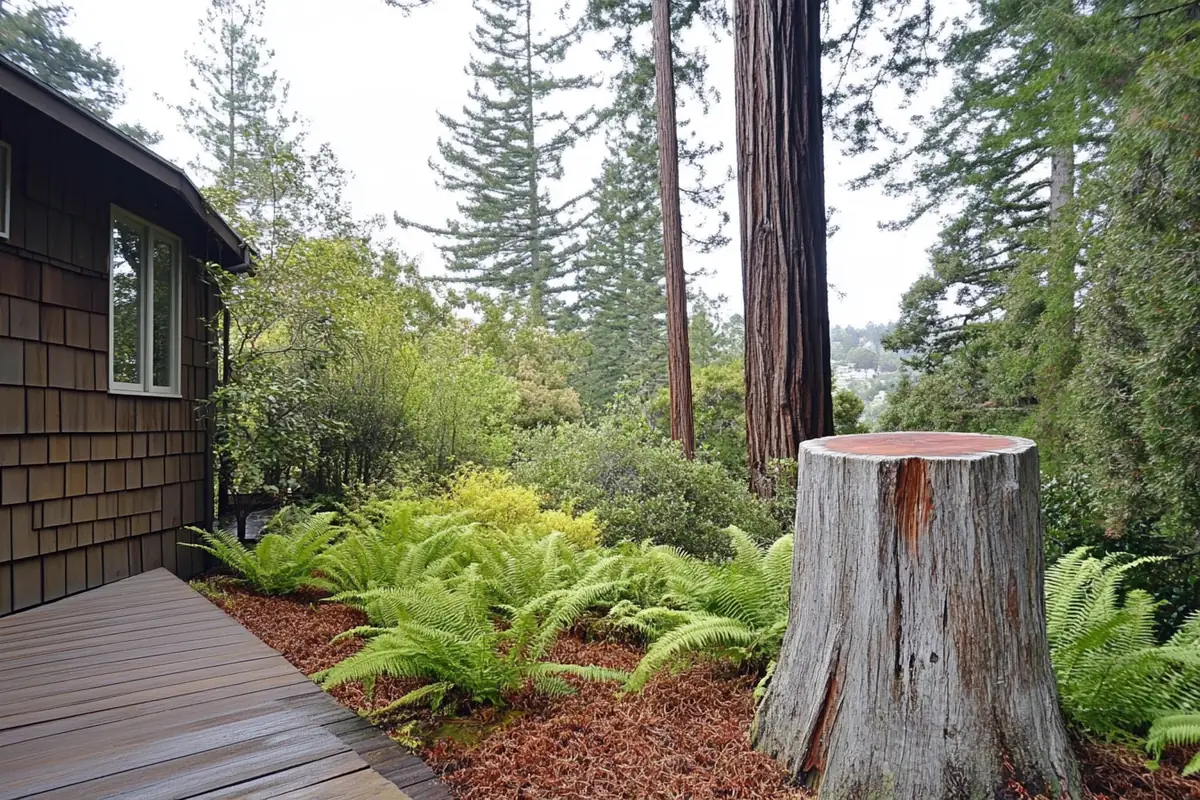
Mill Valley is redwood country, and that shapes almost every stump job here. The canyons running up toward Mount Tamalpais, Cascade, Blithedale and Homestead Valley, are full of second-growth redwoods, and redwood doesn't go quietly. Even a stump that looks modest can sit on a big, old root system. Cut one down and the stump usually sends a circle of new shoots up within a season, while the roots running under the yard push up sprouts of their own several feet away. On top of that, a lot of Mill Valley homes sit on steep, narrow lots with stair-only access from the street, so getting a grinder to the stump takes planning. The flatter streets near Miller Avenue are easier to work, but they come with their own mix of oaks, bays and old ornamentals.
We grind redwood stumps below grade and chase the sprouting roots out with them, so the shoots stop coming back. When something is going to be built on the spot, stump removal clears it fully, and for redwood roots lifting a lawn or path, root grinding flattens them out. Mill Valley jobs often take more planning than grinding, so the first conversation is usually about the route from the street. Describe the stump and the way down to it, and we'll put together a free estimate.
Redwood Stumps That Keep Sprouting
Redwood stumps are the most common call we get from Mill Valley, and the most misunderstood. People cut back the shoots every spring and wonder why they keep coming. The reason is the root system. A redwood's roots stay alive after the trunk is gone and feed new growth from the edge of the stump and from buds along the roots. Clipping the shoots only trims the symptom. Grinding fixes it by taking out the stump and the living wood around its base, below the level where most sprouts start. We also trace the larger roots outward and grind those down, since that's where the stragglers come from. In shady canyon yards, people often grind the stump to open up space for a patio or a sunny vegetable bed that finally gets some light. Redwood is soft next to oak or eucalyptus, so the grinding itself goes fairly fast, but the stumps are wide, and the flare at the base often spreads past the cut surface. If a few shoots show up the following year, a clip low to the ground usually finishes them. Neighbors over the ridge in Larkspur deal with the same redwoods.
Stair-Only Lots and One-Lane Streets
Plenty of Mill Valley homes are reached by a long set of stairs, with no driveway into the yard and nowhere close to park a trailer. Those jobs start with logistics. We look at the step count, the width of the path and any tight turns, then bring the smallest grinder that will do the job and move it down without chipping the steps. Where even that won't work, the stump can be cut down low by hand and finished with portable equipment. Parking matters too, since the trailer has to sit somewhere on streets that are often barely one car wide, so we plan the day around it, sometimes with an early start before the street fills up. If the stairs are wood, we lay boards over the treads so nothing gets marked on the way down. We keep the noise to normal weekday hours and sweep the street side when we're done. Once the machine is in the yard, the work itself is the same as anywhere else, and the same planning comes up on the steep lots in Sausalito and Tiburon.