
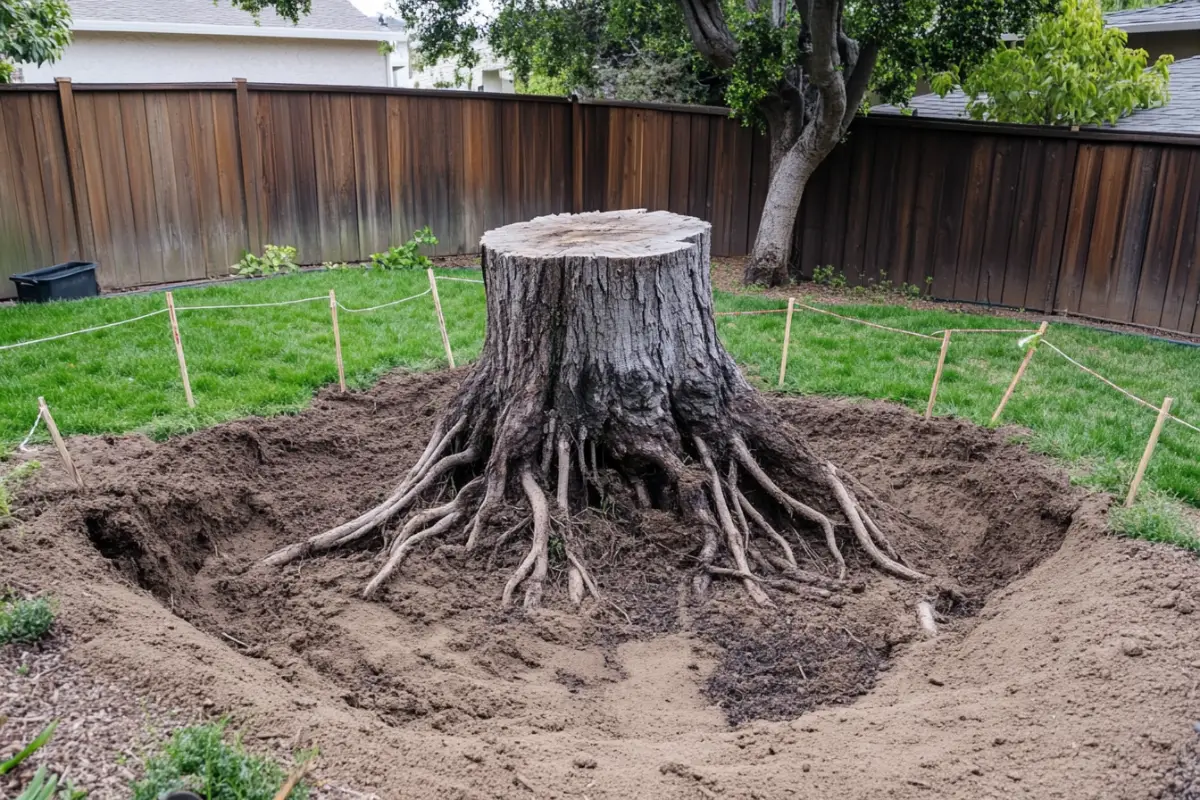
Grinding handles most stumps. Removal is for the jobs where the ground under the stump matters. A lot of those in Marin come from building: an ADU going in behind the house, an addition on a Tiburon hillside, footings for a new deck, a pool, a wider driveway. Leftover wood below the surface is a problem for all of them, because it rots, shrinks and leaves a soft pocket under whatever gets built on top. Stump removal takes out the stump and the big roots attached to it, the part people call the root ball, and leaves a clean hole that can be backfilled and compacted. It's a bigger job than grinding, with more digging and a bigger hole, so we suggest it only for projects that truly need it.
This page walks through the projects that need it, how decaying wood undermines a build, how removal works on Marin's mix of clay, rock and slope, and a quick way to decide between the two options. If grinding turns out to be enough, our stump grinding service takes less time and costs less. In flatter yards like the ones around Corte Madera, removal is usually straightforward.
Projects That Need the Whole Stump Out
The plan for the spot decides it. Marin has seen a steady wave of backyard ADUs, and when one of those lands where a tree once grew, the foundation needs firm, clean soil under it. The same goes for room additions, retaining wall footings, pool shells, concrete slabs and new driveways. If a builder or an engineer has asked for the stump to come out, that settles it. If you're working with a contractor, ask them when they want it gone, so removal fits the build schedule instead of holding it up. Replanting is the other common reason. A new tree set in the exact spot of the old one has to push its roots through a mass of old wood, and it usually struggles. If none of that applies and you want the stump gone and grass back, grinding is almost always enough.
Why Leftover Wood Causes Trouble Under a Build
Wood left in the ground doesn't stay put. As the root ball decays, it loses volume, and the soil above it slowly drops into the space it leaves behind. Under a lawn, that shows up as a shallow dip you can top off with soil. Under a slab, a footing or a paver patio, the same settling turns into cracks, a low corner or a section that rocks. Most of a typical tree's roots sit in the top foot or two of soil and spread wide, with the densest wood right under the trunk. That dense center is exactly where a foundation or footing tends to land. Gravel and sand bases settle the same way, just more slowly. Taking it out before the build is far cheaper than fixing a cracked slab afterward.
Removal on Marin Ground: Clay, Rock and Slope
After the 811 request clears the underground lines, we excavate a ring around the stump until the root ball shows, then cut through the big lateral roots holding it in place. Small and mid-size stumps can often be worked loose once those roots are cut. Bigger ones may need a small excavator where access allows, or more cutting to bring them out in pieces. Marin ground adds its own wrinkles. Heavy clay in parts of the county grips roots hard and goes to soup after a week of rain. Hillside lots often hit rock a short way down. And on a slope, a big root ball can be helping hold the soil, so we look at what's above and below before pulling it. The hole gets backfilled and compacted in layers before we leave.
Grind or Remove: A Quick Way to Decide
Ask what's going on the spot. Lawn, a flower bed, gravel or pavers on sand: grind it. The leftover roots will rot quietly and the ground will stay usable. A foundation, a slab, a footing, a pool or a new tree in the same hole: take it out. Somewhere in between, like a raised bed or a light deck on piers set away from the stump, grinding deeper often does the job. Removal costs more and takes longer, and the hole is bigger, so there's no reason to pay for it unless the project needs it. Tell us what you're planning and we'll give you a straight answer, with a price for whichever one fits. If you're still on the fence, we can price both on the same visit.
And when the stump is gone but roots are still lifting a path or ridging the lawn, root grinding takes care of what's left.
Common Questions
Not all of them. Grinding removes the stump and the tops of the big roots right around it, down to the depth we set. The root ball below that, and the roots spreading out across the yard, stay in the ground and rot over the next several years. For a lawn or a garden bed, that's fine. If you need the roots gone for a slab or a footing, that's what full removal is for, so mention it before the job is priced.
Yes, and removal is the cleanest way to make that work. Once the root ball is out and the hole is backfilled with good soil, a young tree can go right in the middle. After grinding alone, the old wood is still down there, and new roots have a hard time growing through it. In that case, shifting the new tree a few feet off the old spot usually solves it.
Plenty of Marin stumps sit where no excavator can reach, down a set of stairs or behind a house on a hillside. Those come out by hand and with smaller tools. We dig around the root ball, cut the lateral roots with saws or a compact grinder, and break the stump into pieces small enough to carry out. It takes longer than machine work, which shows up in the price, but it gets done without tearing up the path in.